Sunday, January 2, 2022

Nepalese / Tibetan travelling salesmen


 How time flies.

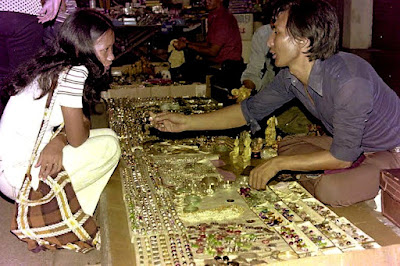
50 years ago seems a short while when I look at this picture taken at a five-foot way in Bintulu.
In the 70's along the five-foot ways of old Bintulu shophouses, there was a constant arrival of a breed of travelling Tibetan/ Nepalese salesmen who traded an assortment of tiny ornaments of antiquity, rings, bangles, amulets, tiny Buddha statues and lots more for the curious and ardent believers of these religio-spiritual items.
I don't seem to stumble upon them as we move into the second decade of the 21st century.
Where have they gone?

A dentist treats a rural school student


 50 years ago, you are a rural school student in Bintulu.

This is how the best dentist in town will treat you.

Hold on to your wooden chair and gather your friends by the window for moral support.
Those were the days.
Note: Picture taken in early 70's, shows Dr Roff, attached to Bintulu hospital on his travelling assignment to out station schools.

Thursday, December 10, 2020

Bintulu's products to Singapore : A look back into time.


The wharf at New Harbour was named "Borneo Wharf" because it was the property of Borneo Company. The Company built its first wharves at New Harbour in Telok Blangah in 1856, Singapore.

Photo credits: Reminiscences of the Straits Settlements Through Postcards, 2005. pg.53

When we study Bintulu history, we will encounter a time when the Borneo Company Limited (BCL) or more popularly referred to as Borneo Company, was a big name in the local business who's who.

1856 was a hectic year for the first Rajah of Sarawak, Sir James Brooke.  In May that year at London he had the BCL registered as a joint-stock and limited-liability company through his proxies.

In July the same year, the Borneo Company was registered in Singapore and the next year in Kuching, Sarawak.

The Borneo Company was in fact a commercial monopoly arm of the Rajah to exploit the business opportunities in Sarawak. 

From the Bintulu historical perspective, it is to be noted that sago and Belian timber were the prime products sent to Kuching and then to Singapore by the Borneo Company.  During the early years of business networking of the Borneo Company, Bintulu's sago was one of the best quality much sought by Kuching people and the  Singapore market.

In Singapore, there is wharf facility called "Borneo Wharf" which belonged to the Borneo Company (see picture attached)., where Bintulu's products were off-loaded.

For more stories of the Borneo Company's operations in Bintulu, please check them out in another of my blog by following this link...>>>https://bintulub4now.blogspot.com/.../Borneo%20Company..
Thursday, November 6, 2014

Reminiscing the old Bintulu


On the 16th of September, 2014 the above story was published by the Borneo Post.  The full story can be accessed online at Borneo Post news portal here.

Saturday, August 31, 2013

Bintulu - 50 years within Malaysia

View of Bintulu town from top of Li Hua hotel
Date taken : 30 August'13
Soon Bintulu will celebrate its 50 years of independence within Malaysia which will be on the 16th of September 2013.  I am thinking of seriously going back to blogging about Bintulu in blogger.  So today I'm showing a picture of the Bintulu town which has expanded towards the north since it started to join in the ranks of the newly developed towns of Sarawak starting in late 1970's with the coming of the first economic boom to this once sleepy town and fishing village.  Bintulu is now in its fourth economic boom period.

Friday, June 18, 2010

Early local government practice in Bintulu

Some notes:
1) In 1947, the Bintulu " Local Treasury" was set up. This was part of the British scheme for the development of local government through local authorities with their own treasuries and with the passing of the Local Ordinance, the powers and responsibilities of the Bintulu Local Treasury were defined.
2) The basis of the local treasuries was a government grant of $5 a taxpayer and retention by the local authority bodies of customary taxes, against which they assumed responsibility for primary education and payment of chiefs' salaries.
3) Inadequate finance, a limited field of interest and a dearth of qualified staff resulted in disappointing early progress. On top of this, the authorities continued to suffer from disadvantaged of remaining primarily racial in character.
4) In 1959, a general election of representatives to Bintulu District Council was held ( besides other towns in Sarawak)
5) Council Negeri Sessional Paper 1/59 defined the ultimate responsibility of local authorities in the field of primary education and introduced a system of matching rate grants as a means of encouraging the extension of the rating principle in conjunction with generous central government capital grant and loan assistance.

Source:
The above points were highlighted by Mr. John Moods report and the extract was included in a special edition of the Sarawak Gazette Publication called " Sarawak Gazette Delima Edition", published by the Chief Minister's Office in 2003.

Wednesday, June 16, 2010

Betting

The coming of the Chinese in Bintulu early history brought in more inter-cultural exchange. However, exchanges done at the market place has resulted in a "plural society" and the meaning of transaction in monetary contractual terms. The Chinese 'habit' of gambling put transaction in a speculative context. Later, in modern history when democratic elections were carried out in Bintulu, stiff election campaigns can be affected by a market for betting on the outcomes of election results. Are they any studies on the effects of betting on local elections in Bintulu?

Tuesday, June 15, 2010

Introduction

I am inspired to start blogging about a proposed book that have made me thinking for quite a while now. Today while in Kuching I decided to create a blog on it. Entitled " Bintulu Perspectives", it will provide a balanced view about the history and development of Bintulu. The blog will attempt to record my thoughts as I progress on writing the book. More about this later. The book will provide a thematic treatment which could be grouped under Labels in the blog as per list below:
Themes Research Methods Chronology

Historical Snapshots Business growth Personalities

Local History Modernisation and Change Cultural Values

Social Problems Entrepreneurship Millenium Challenges